Time Period: 30th July 2019
This blog post won’t be about my feelings about leaving my job, my thoughts about travelling or important life lessons I should have learned years ago. It’s going to be about elephants. Why? Because ELEPHANTS ARE AWESOME.
Around a month before we flew to Thailand, Alice and I worked out that we were scheduled to be in Chiang Mai for Alice’s birthday. So we looked up the top 10 things to do in Chiang Mai, and there was a clear winner. The Elephant Jungle Sanctuary – a haven for elephants who have been rescued from logging and riding camps, and circuses. Kind of like an elephant retirement home. Cue lots of excited pointing at my laptop screen and smiling from Alice.
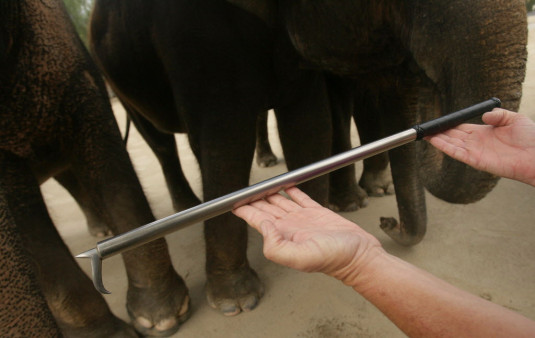
As an aside, you probably already know why elephants need to be rescued and cared for. Elephants can only be trained for riding or circus performances using especially brutal ‘taming’ methods. Chaining elephants (often baby elephants) up in a tiny pen where they can’t move, and are not given food or water for days, is the traditional method for breaking an elephant’s spirit (“Phajaan” in Thai) – and that’s just the start. During their confinement, elephants are beaten and wounded with bullhooks wherever the elephant’s skin is thinnest – behind the ears, around the eyes, and also around the feet, trunk and mouth. This kind of abuse gives elephants a lifelong fear of the bullhook, which is often used to maintain control of them during riding and performances. Moreover, riding elephants can leave them with chronic spinal injuries over long periods of time. If you want more detailed information about elephant abuse, you can find it here at: https://www.elephantvoices.org/elephants-in-captivity-7/
So, back to the elephant sanctuary. The journey there was an adventure in itself – a 90 minute drive from Chiang Mai’s old city, the last 30 minutes of which climbed through jungle-covered mountains. The steep, winding, rocky descent into the sanctuary itself revealed why we were in the back of a 4×4 pickup truck as opposed to an air-conditioned minibus.
On arrival, we were given traditional Karen hilltribe outfits to wear, and a brief history of the sanctuary. It turned out that our driver was also our host – he was extremely proud of the sanctuary and grateful for the camp’s new marketing team. Our host had worked with his herd in a riding camp for 10 years in order to make enough money to feed the herd, and only over the last 6 years in this sanctuary had it been possible to make enough money to feed them without exploiting the elephants for work. He told us that in the past, when they couldn’t make ends meet, he had been forced to set free two of his elephants into the wild. Later, he found them dead – poisoned by pesticides from farm crops. He had learned his lesson the hard way. It was very clear that he genuinely and passionately cared about the animals and was very keen that they shouldn’t be used for work any longer.
After the orientation, we were each given a huge bunch of finger bananas which we were told to peel – it was time to feed the elephants. Going down the slope, the elephants came to meet us when we shouted ‘Bon bon!’ – which meant feeding time. These first 10 minutes of getting used to being in close proximity with such large creatures were probably the most eye-opening of the day. We had been taught that elephants don’t have great eyesight or field of vision – so we needed to keep in front of them, where they could see us. But nothing quite prepares you for a creature weighing up to 5,000+ kg lumbering straight towards you, the image of a tiny banana locked into its alert, black eyes.
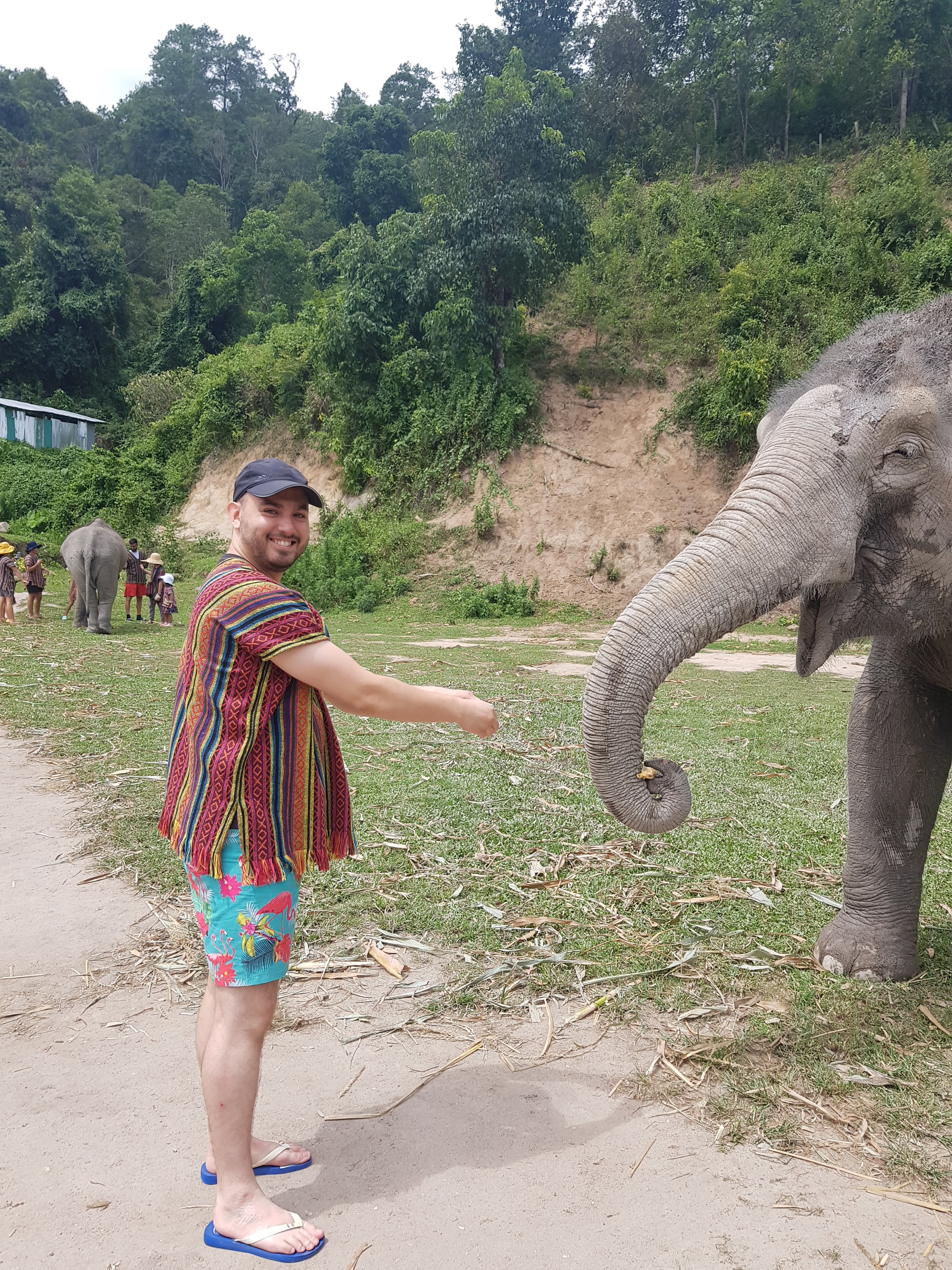
The first thing you learn about elephants when you meet them up close is that they’re very, very hungry, and very, very greedy. And I don’t mean to offend my giant comrades – it’s just a matter of physiology. Elephants need to eat around 10% of their body mass per day (i.e. around 300+ kg PER DAY!), due to the inefficiency of their digestive systems. They aren’t like cows or oxen which spend a long time chewing and processing their food – they barely chew, and pass food very quickly. In the succinct words of a sanctuary worker: “Quick in, quick out!”.
And what that means for tourists is that it’s very easy to feed elephants – either by holding bananas out in front of you for them to grasp with their trunks, or straight into their mouths. The tricky part is to stop them reaching into your pockets with their deft trunks to steal your unpeeled yellow treasure. Whilst they’re happily munching away, its easy to stand near their heads and stroke their incredibly thick, hairy, rough skin – or sneak in a much-coveted photo op.
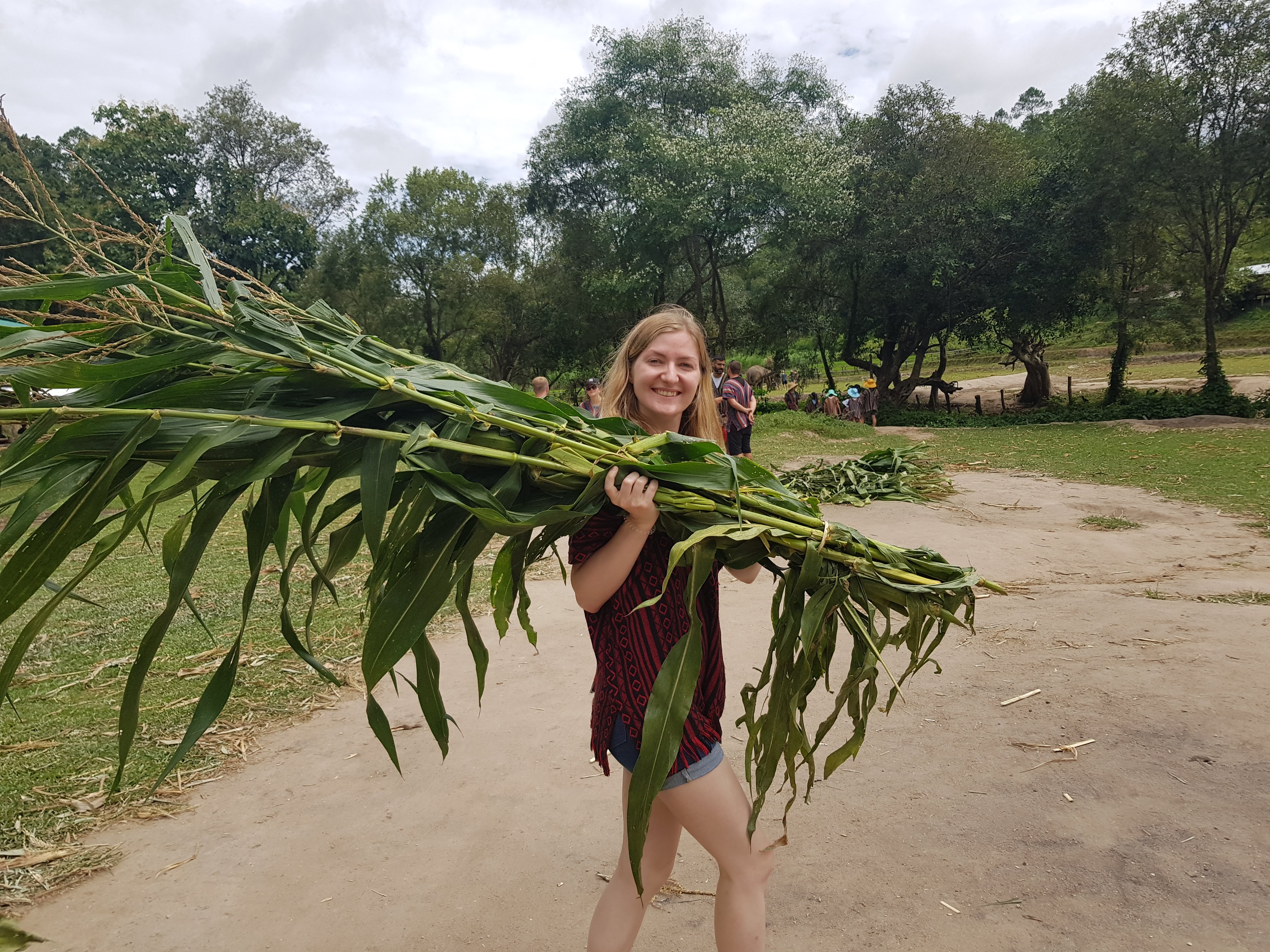
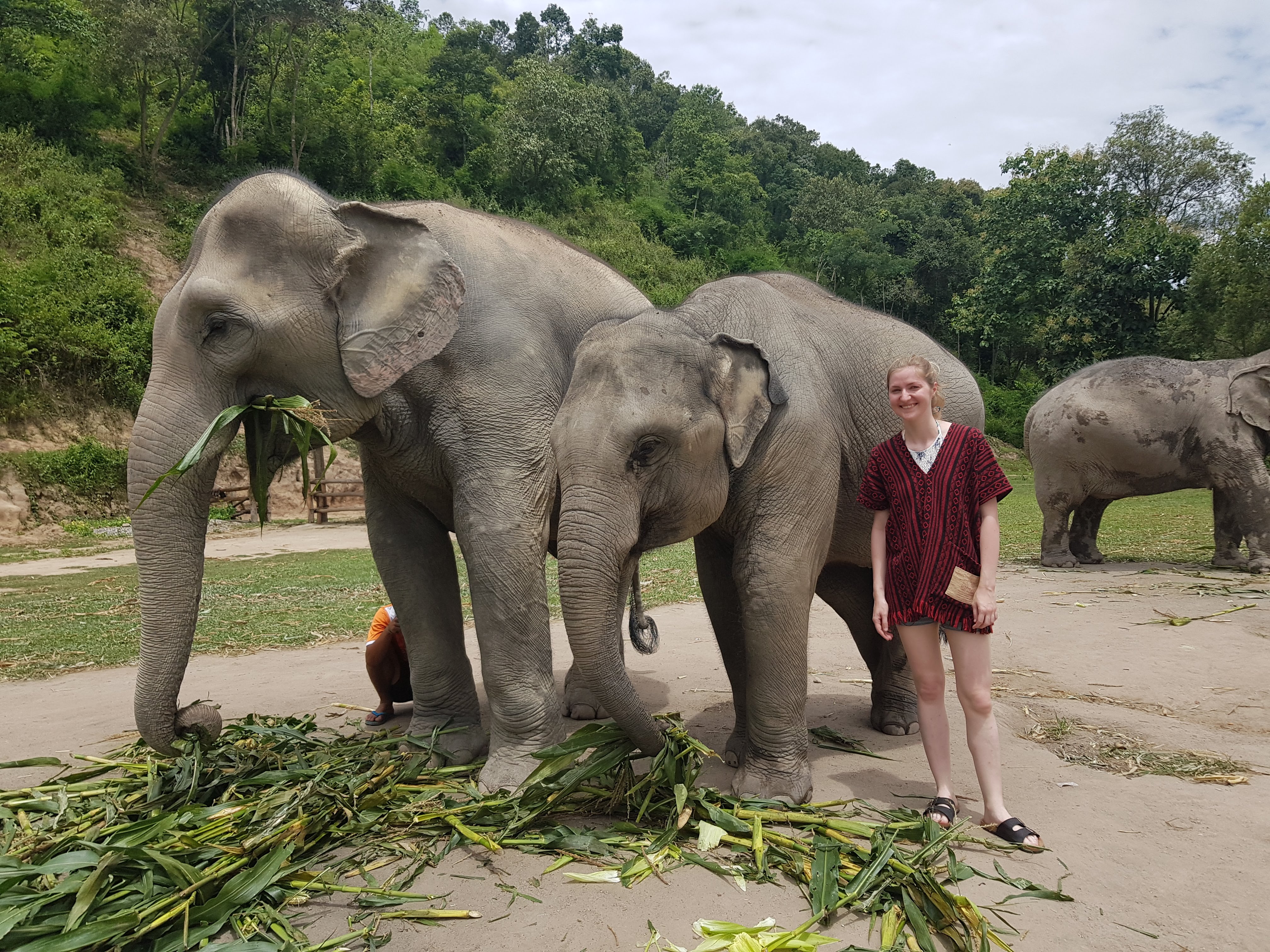
A whole bunch of bananas doesn’t get anywhere near to the 300 kg mark though. Our next job was to fetch huge sheathes of corn down from the hillside and arrange them in an enormous pile. The elephants quickly set to work stripping leaves and whole cobs, gripping and twisting the thick stems with their powerful trunks and shovelling in impossibly huge mouthfuls. At this point, some elephants were quick to drag away their own personal piles of corn, using their bodies to protect their impromptu stash from their compatriots. All’s fair in love and corn.
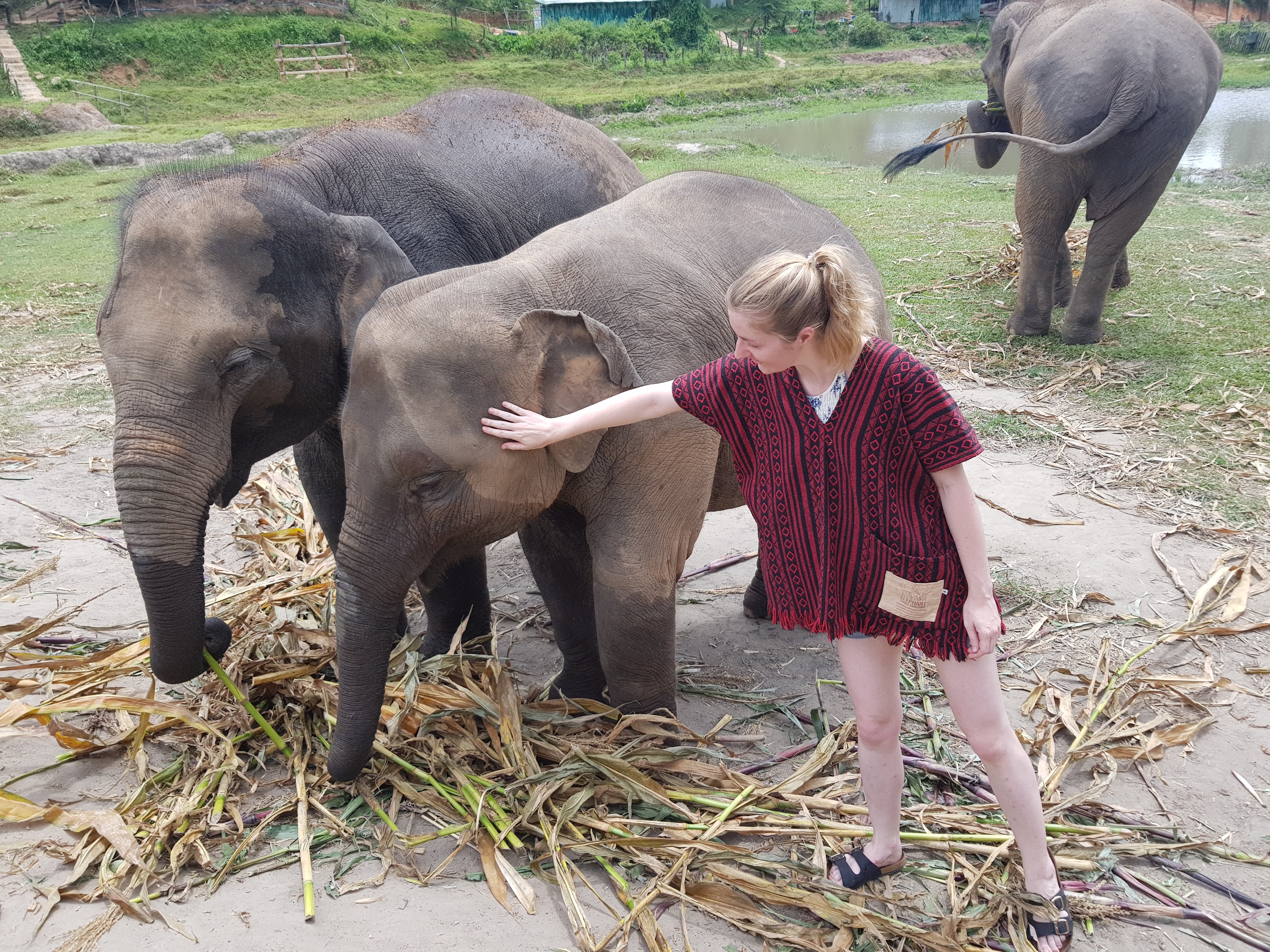
After a very tasty home-cooked lunch, we visited the elephants of a nearby camp – in fact, the Elephant Jungle Sanctuary in Chiang Mai is home to more than 100 elephants, which are split into herds of around 6 – so there are a multitude of camps in one place. The camp next door had two baby elephants (nicknamed Beyonce and Rihanna!) which unfortunately remained surrounded by a mob of excited young girls for the rest of the afternoon – probably the most predictable part of the day.
The next hour we spent making – believe it or not – ‘elephant medicine’. Using the biggest mortar and pestle I’ve ever seen, we pounded a concoction of iodized salt, raw rice (still in its husk), tamarind, finger bananas and cooked rice into a thick paste, and then rolled it into snow-ball sized spheres with our hands. These small balls are, we learned, extremely helpful for making elephants pass their food easier, and for protecting their throat and digestive system from damage by the rough fibres of the unchewed corn they swallow. They’re even more important for elderly elephants – or, as the sign said, ‘geriatric’ elephants! When we brought the medicine balls to our gigantic new friends, some of them pretty much charged us in excitement and anticipation – it turns out elephants take their medicine better than most humans. Don’t worry, no-one was crushed – and our host made sure that all the elephants got their fair share of medicine – not just the first ones to the party.
And just when we thought it couldn’t get any better, it did. It was bath time for the elephants. First, a thick coat of mud to keep the mosquitoes and ticks off their skin and keep them protected from the sun – and secondly, a water bath underneath a small waterfall. Here we were given large tubs to splash water all over the elephants – and each other – to our heart’s content. And just to show how in tune this sanctuary is with the insta-generation, there was even a photographer present, just so you wouldn’t need to get your phone wet.
I’m not sure this needs saying – but just to be clear, standing in a waterfall and splashing elephants with water is exactly as fun as it sounds. Maybe it was my imagination, but I could have sworn I saw them smile as they were being bathed.
Just before we went home, there was a final opportunity to get some photos as the elephants fed on another meal of corn sheathes – but most people felt content to stand there watching, still marvelling at their size, beauty or maybe the sheer amount of food they could eat. Apparently, elephants spend between 12-18 hours eating per day, and only sleep for around 3 hours per night, to maximize feeding time. Told you they were greedy! And before you get there, Alice has already drawn the obvious comparison between me and elephants in this regard, so don’t bother saying it again…
To learn more about the Elephant Jungle Sanctuary, visit: https://elephantjunglesanctuary.com/ or see some great photos or videos on their facebook page at https://www.facebook.com/elephantjunglesanctuary/. The Elephant Jungle Sanctuary has centres in Chiang Mai, Phuket, Pattaya and Samui.


Interesting, original ! Did you go down the hill in the same 4 by 4 ? Vehicle?
LikeLike
Sounds amazing!
LikeLike