Way back before we went travelling, we read about a place called Da Nang – Vietnam’s third largest city (behind Ho Chi Minh and Hanoi). Just from flicking through a couple of travel guides, we thought there was so much to do there that we should make it one of the longer stops on our 49-day tour through southeast Asia.
We initially planned to spend five days there. In the end, we extended our stay to eight days – and we still felt like we had missed out on some of the amazing experiences that Da Nang and its neighbouring towns had to offer.
On reflection, it’s the perfect place to go for two straight weeks (maybe more) – and you won’t be bored for a single day. Whether you’re going travelling or taking your annual long holiday from work, and regardless of whether you’re single, in a relationship or have a whole family to take with you, Da Nang is the ideal destination.
Let’s get into why!
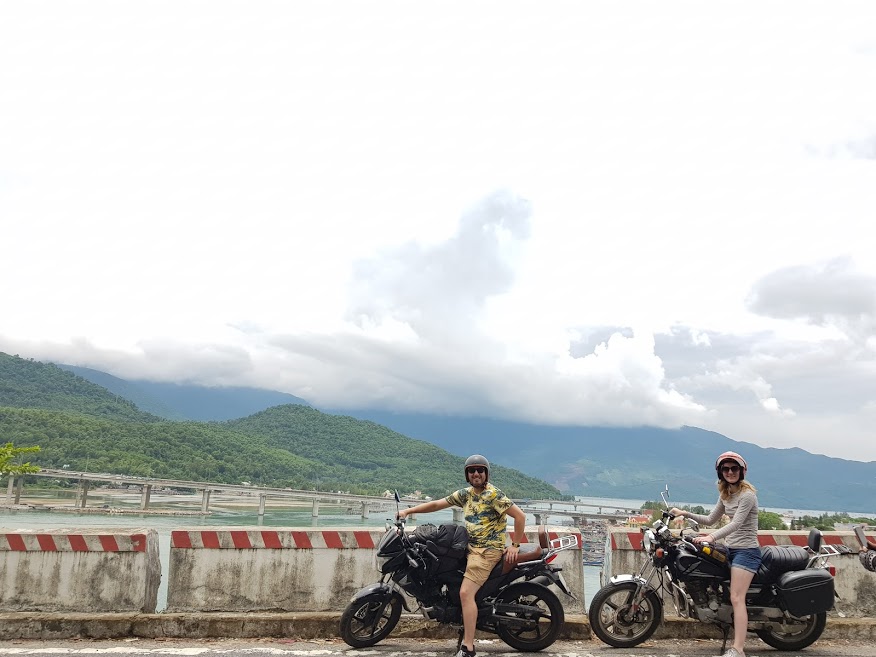
It’s home to the Hai Van Pass
Those who have seen the Top Gear special where Clarkson & Co ride scooters over the incredibly picturesque Hai Van pass will need no introduction. For those who haven’t, the Hai Van pass is the middle stretch of a 120km journey between Hoi An and Hue, along which you’ll ride past the beautiful and historic Marble Mountains, the breathtaking and incredibly long My Khe beach, 500m altitude coastal mountains that almost touch the clouds, and the unbelievably serene Lang Co beach. Long straight roads are punctuated by scooter-congested Vietnamese traffic, steep climbs and hairpin bends, keeping the adrenaline high at every turn.
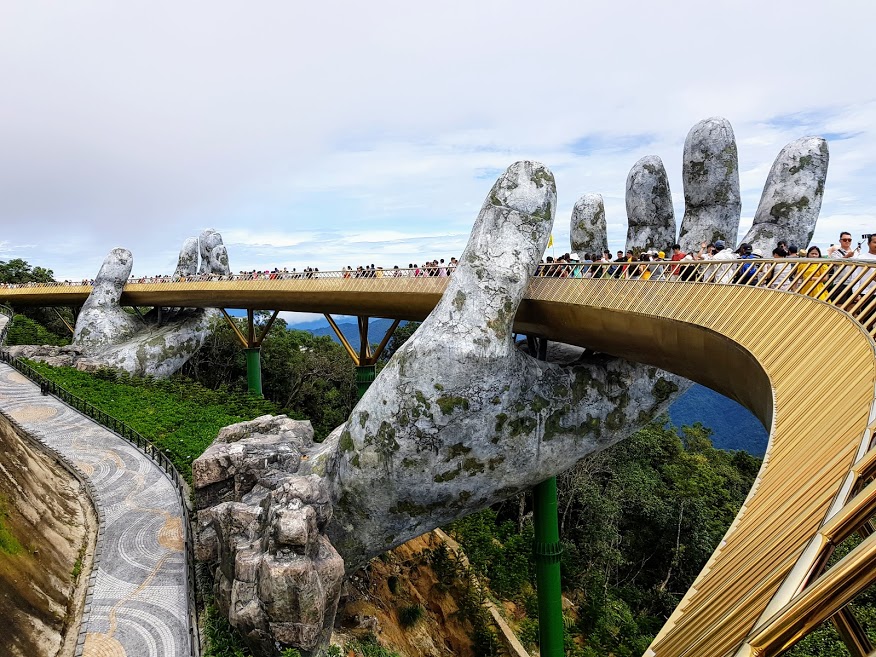
The golden bridge at Ba Na hills
Essentially Vietnam’s answer to Disneyworld, the Ba Na hills (owned by Sunworld corporation) are a majestic sight to behold, and are designed to be adult adventure playground and child fantasy park in equal measure. Once you’ve ascended the awe-inspiring, fifteen minute, 5km cable car ride (the longest in the world), you’ll arrive at Ba Na’s primary asset – the golden bridge, held up by giant, moss-covered hands, overlooking a landscape that includes Da Nang city, My Khe beach, and Son Tra mountain. If that wasn’t enough, the hills are also home to 9 differently themed gardens, a 100m wine cellar tunnel dug into the mountain, a funicular railway, a French-themed village, a giant buddha statue, a mountain-top tea-house, a beer plaza and of course, a kid’s fun park. The pictures you’ll get will be good enough to break Instagram – but only if you’re tough enough to elbow all the other photo-mad tourists out of the way long enough to get a picture.
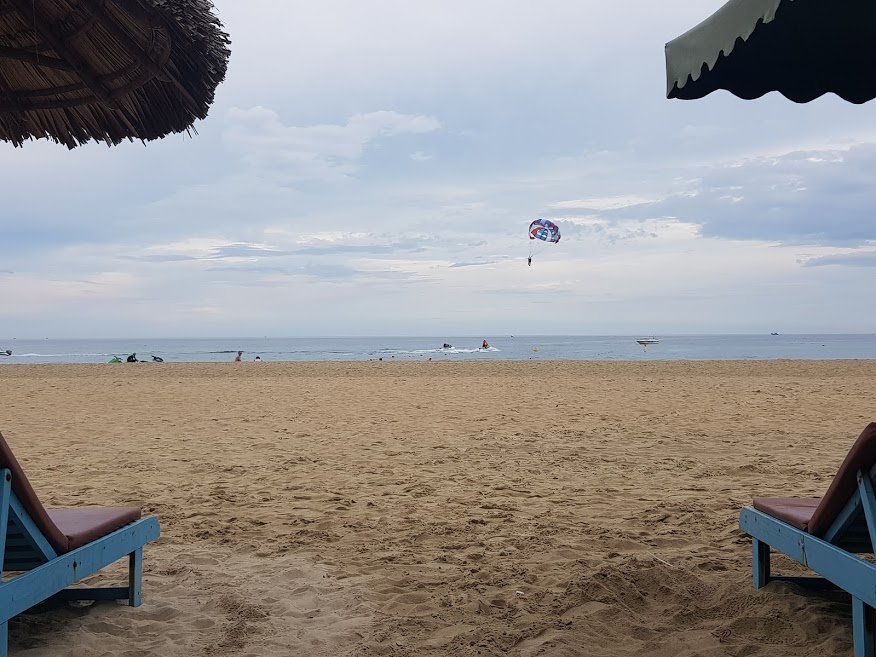
The beaches are some of the best in the world
Where to start.
Da Nang’s local beach, My Khe, is 9km long. If you’re prepared to walk or get dropped off only 1-2km from its busiest area, you’ll almost certainly be treated to a stretch of sand that feels almost private. Many sun loungers are free if you buy a coconut or a beer. You can order fresh seafood from restaurants that back onto the beach itself. The sand is soft and clean, and the ocean is shallow enough that you can wade out for a good 50m and only be up to your shoulders. And if you get bored, you can try parasailing or rent a jetski.
And that’s just the start when it comes to beaches. Along the Hai Van pass, you’ll be able to stop at Lang Co beach, which is incredibly unspoilt and tranquil. In Hoi An, Ang Ban beach was voted in CNN’s top 100 beaches in the world. And if you just want to mix it up, you can get to Non Nuoc beach which is only around 20 minutes away – and was voted in the top 25 Asian beaches in TripAdvisor’s 2017 Traveller’s Choice Awards.
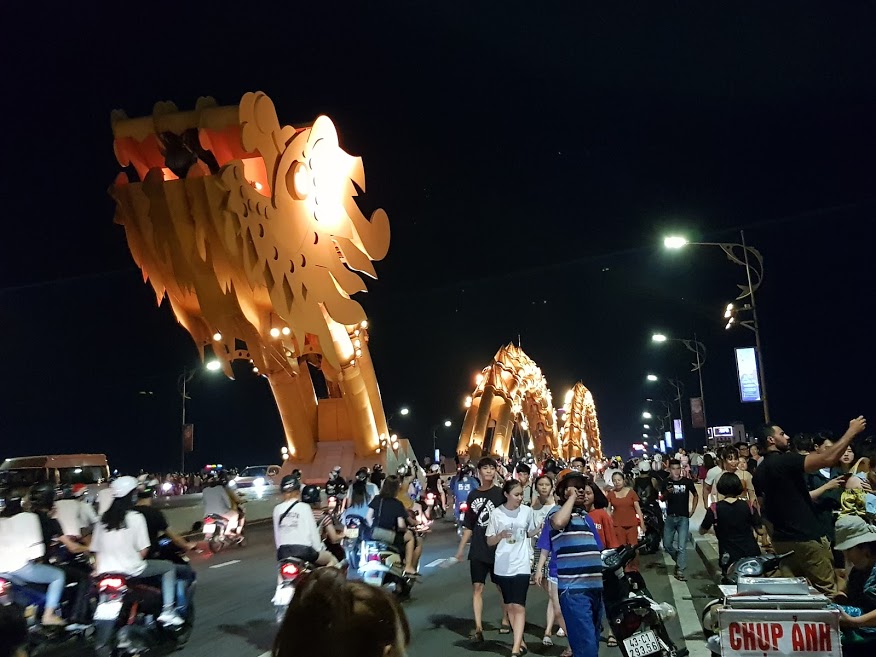
It has a bridge in the shape of a dragon that breathes fire
The Dragon Bridge in Da Nang is not only a triumph of architectural and engineering creativity, it’s also a heart-warming throwback to childhood that will capture yours (and your children’s) imaginations. Just to be clear here – yes, it’s a huge, huge bridge in the shape of a dragon. But at 9pm on Saturdays and Sundays, all traffic going across it is stopped, and it becomes more than just a bridge shaped like a dragon, and starts behaving in a very un-bridgelike manner. Underneath its head, thousands of excited onlookers suddenly break out into sweat as massive, searing-hot jets of flame shoot from its mouth, and are then drenched by a huge deluge of water cannoned from the same orifice. It’s an event of fairy-tale proportions made even more special by the atmosphere on the bridge as so many people of diverse backgrounds come together to witness a dragon come alive.
Hoi An, Hue, and My Son are all nearby
Da Nang city has everything you need – huge shopping malls, traditional Vietnamese markets, high calibre hotels and restaurants. But probably Da Nang’s biggest asset is its location – in close proximity to the small, historic town of Hoi an, the ancient temples of My Son and the royal mausoleums of Hue.
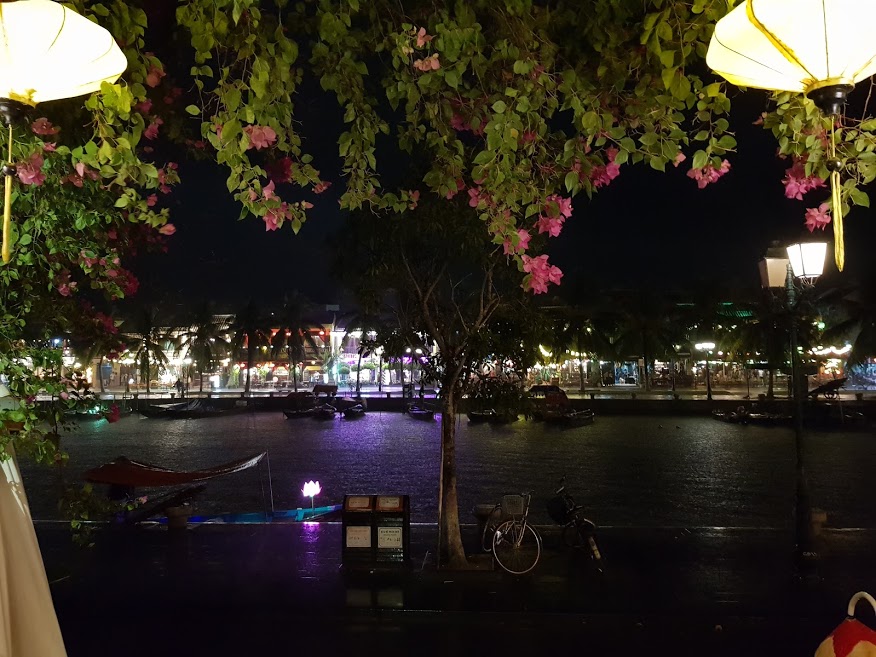
Hoi An is famous for, among other things, having over 400 tailors where you can get measured for a custom made suit or dress for a fraction of the price it might cost you back home, a thriving art scene, a charming ancient town centre, a top-notch night market and the best banh mi in Vietnam (according to the late chef, Anthony Bourdain). As it’s only a one-hour bus ride from Da Nang, it’s almost impossible not to visit if you go to Da Nang, and provides a quieter, more chilled-out and more culturally established alternative to Da Nang’s fast pace.
In between all the beaches, bridges and tailor-made suits, it’s also healthy to get a good dose of history, both ancient and modern. Da Nang’s Zone 5 Military Museum has a great deal of Vietnam’s modern history covered – its three floors catalogue the Vietnam war and resistance of French colonialism. But for ancient history, the My Son sanctuary, a UNESCO world heritage protected site, constructed between the 4th and 13th centuries, is only 40km from Hoi An. Within south east Asia, My Son’s temples are only exceeded in beauty by Ayutthaya in Thailand and Siem Reap in Cambodia.
And north of Da Nang, at the other end of the Hai Van pass, is Hue. This city embodies another fascinating period in Vietnamese history, encompassing the vast 19th century citadel that was the capital of the Nguyen dynasty, and the ostentatious tombs of its emperors. And 20km outside of Hue is the ghost city of An Bang, where hundreds of incredibly ornate (not to mention expensive) modern tombs have been built to honour the ancestors of the local residents.
Vietnamese food and drink
Those who have been to Vietnam probably won’t need much convincing that Vietnamese food is incredibly delicious! It’s generally simpler and less spicy than Thai food, which makes it far less daunting to try even for the fussier eater. If you go to Da Nang or anywhere in Vietnam, then you won’t regret trying these – and this is just scratching the surface…
- Pho (noodle soup) – especially beef
- Banh Mi – baguettes filled with pork, herbs, spices and sauce, and incredibly cheap (around 60p each off the street – perfect for lunch!)
- Banh Cuon – steamed rice rolls
- White Rose dumplings – a Hoi An speciality
Suggested Itinerary
This is an itinerary I’ve dreamt up recently based our own eight day stay. I’ve not tested it out – so be sure to do plenty of research as you normally would before booking anything! We didn’t actually make it to Cham island, My Son or Hue, so the information in these sections comes from research rather than first-hand experience.
Day 1 – Fly to Da Nang
The flight should only need one connection, at Hanoi. Da Nang has its own airport which is only a few minutes’ drive from the city centre. If you’re flying from the UK, then with the time difference (you’ll be losing time) the journey will probably take almost a full 24 hours.
Day 2 – Relax at My Khe beach
After the slight jetlag, you’ll probably want to spend a day relaxing – so My Khe beach will be perfect. Just bring your swimwear, a towel, some sunscreen (even if it’s cloudy) and a kindle or some headphones. There are multiple places where you can go parasailing for a reasonable price, although the time spent up in the air is quite short. Grab a sunlounger and after you’ve sipped your coconut dry, ask for it to be split in half. Before you have time to get scared of the middle-aged Vietnamese woman so expertly wielding a machete, you’ll have two halves of a coconut and a spoon to dig out the fresh, delicious, healthy coconut meat.
If you flew on a Saturday, then this day would also be perfect for seeing the Dragon Bridge show, which is only at 9pm on Saturdays and Sundays.
Day 3 – Explore the Marble Mountains
You can easily get the number 1 bus (Da Nang – Hoi An) to the Marble Mountains, which are around 45 minutes from Da Nang – live timetables should be on Google Maps. There are five mountains that make up the Marble Mountains – but the biggest and most attractive by far is Water Mountain. My advice is to pay the small fee to catch the lift tower to the top, as you’ll be doing plenty of climbing when you’re up there in order to reach its various different peaks. When you buy a ticket, don’t forget to buy a map too – some careful planning at the start will mean you won’t miss its numerous caves and pagodas, all of which are worth seeing.
Day 4 – Walk along the golden bridge at Ba Na Hills
You can easily arrange for morning pick up and an afternoon drop off with a shuttle bus service such as Da Nang Green Travel. There’s no need to hire a tour guide here, as the Ba Na hills is primarily a modern fantasy park rather than a historical monument, and you’ll want the flexibility to decide for yourself how long to stay in each area. When you get there, my advice is to see the golden bridge in the afternoon, after the morning rush of photo-junkies. Just be warned that the Ba Na hills attract tourists from just about every culture, and every single diverse definition of what constitutes ‘rude’ and ‘polite’ behaviour can be observed here. Basically, try not to get too frustrated by other people barging in and through your perfectly aligned photo – and be prepared to wait patiently for other people to finish taking theirs. If you have young children, consider splashing out for one night’s accommodation in the resort – then spend one day visiting the gardens and French Village, and one day queuing for rides in the fantasy park (skip out the museum day in that case!).
Day 5 – Visit the Fifth Military Zone Museum and/or the Cham Museum
At the Fifth Military Zone Museum, walk around outside marvelling at all the impressive military vehicles whilst you contemplate how many lives were taken away using them. Inside, the museum’s arrangement is a bit peculiar as it flits between ancient history, the Vietnam war and resistance of French colonialism – however, if you persistently read the broken-English captions of each photo and exhibit, you’ll effortlessly absorb a dose of Vietnamese patriotism as you realise just how many invasions that this fearless country has repelled.
At the Cham Museum, you can see almost 300 terracotta and stone works sculptures ranging from the 7th to the 15th centuries, carved by the indigenous Cham people, heavily influenced by Hinduism. This is the largest exhibition of Cham sculpture in the world.
Day 6 – Take a speedboat tour of Cham island
Cham Island is home to such incredible marine life that it has UNESCO biosphere reserve status. And after a conservation project running from 2015-2017 where more than 2,700 groups of coral species were planted, its coral reefs are now thriving. You’ll be able to book a one-day speedboat tour to the island, its beaches and satellite islands – most include snorkelling, so you can see the reefs!
Day 7 – Explore Hoi An ancient town
Upon arrival in Hoi An, if you want a custom-tailored suit or dress, go straight away into the centre and browse through a few tailor shops before making a decision about which one to go with (don’t feel trapped into using the first place you go to!). Once you’ve done that, grab the world’s supposedly best Banh Mi at Banh Mi Phuong, visit the Japanese Bridge, get a coffee in Reaching Out Tea House (run by local deaf people) and for dinner, taste some iconic White Rose dumplings at the White Rose restaurant. Once it hits 7pm, cross the bridge of lights to visit the night market, and top up your stomach with some amazing street food, including rolled ice cream.
Day 8 – Get twirled around in a basket boat
For extra points, rent some bicycles from your guesthouse (usually its free or very cheap!) and cycle through the rice paddies on some excellent paved bike paths to reach the riverside (around 5-6km). Basket boat tours through the Nipa palms are relatively cheap, and are incredibly relaxing and pretty (as long as the weather holds up). At some point, you should get an opportunity to see one of only five professional boat-dancers undertake a gravity defying dance – make sure your boat captain gets you a close-up view!
Day 9 – Be in awe of the ancient temples at My Son
My Son is around an hour away from Hoi An, so you’ll need to organise a tour or transport in advance. The entry fee of around £6 includes entry to the temple complex as well as a museum, which is incredibly good value.
Day 10 – Relax at An Bang beach
Once again, rent some cheap bicycles and enjoy the quiet Hoi An countryside on your way to the beach. Get your coconut split open after you drink it – it’s a two-part experience!
Day 11 – Motorbike along the Hai Van Pass to Hue
Motorvina were the cheapest tour operator we could find, and their service (from the booking desk and the riders themselves) was excellent. However, they don’t carry insurance, so make sure your travel insurance covers you for this activity. If you’ve ridden a motorbike or scooter before, you should be fine to follow one of the bike professionals through the hectic traffic and round the tight uphill bends. If you haven’t, tour operators might be able to accommodate you as motorbike passengers only (they did for me and Alice). If you have a family or are in a group, consider getting an open-top jeep (which is more expensive than bikes) or a car (which is less expensive than bikes). Lastly, you’ll already have explored the Marble Mountains if you’ve followed the above itinerary, so you can ask to skip this section out and spend more time at the beach, or spend time exploring the Hell Cave in the Marble Mountains if you missed it first time around.
Day 12 – Explore Hue’s Imperial Citadel and Tombs
On your first day in Hue, you’ll probably want to visit the Imperial Citadel, and the Tombs of Tu Duc, Minh Mang and Khai Dinh. If you have time, you’ll also want to walk along the perfume river and visit the Thien Mu Pagoda.
Day 13 – Wander the Ghost City of An Bang
Getting to this ornate graveyard previously proved to be a bit tricky, but now organised tours operate to take you to the area in a car or SUV (although they seem a little bit pricey). If you’re alone or in a couple, consider hiring a scooter to reduce the cost.
Also you may want to travel back to Da Nang in the afternoon and stay overnight there, due to its proximity to the airport, depending on if you have an early flight the next day.
Day 14 – Fly home
If you just want to do a 12 day holiday so that you have a couple of days to chill out at home before going back to work, you could skip out Hue (in that case, you should take the Hai Van pass ‘loop’ tour which takes you back to Hoi An).
Some things to note in Vietnam:
- Vietnamese traffic is some of the worst in the world – in my opinion far worse than Thailand, Laos or Cambodia. The sheer amount of scooters whizzing around means that you might think it’s impossible to cross the street, at first glance. Just wait for a small gap and have faith that those scooter drivers will drive right around you. If you have kids, hang on to them, or better yet, carry them.
- If you’re white, you are likely to get more than a few lingering looks from curious locals. This is more common in the poorer parts of Da Nang rather than Hoi An, which is very naturalised towards tourists.
- Transactions in Vietnamese Dong contain a lot of zeroes, even for small purchases, so watch you are handing over the right note – make sure you are handing over 10,000 not 100,000, for instance. As soon as you get cash out, you’ll almost certainly be a millionaire!
- If you’ve heard that Vietnamese people are incredibly polite or charming, then that may well have been true for the person who told you that, but don’t expect anything out of the ordinary. Our stay in Vietnam included dealing with a great variety of people, some of whom were incredibly nice, and some who weren’t – it’s no different to anywhere else in the world (which is not a bad thing).
- Download Grab. Whilst riding in a tuk tuk is fun, Grab taxis are far better value, safer and will get you to the right place.
 The Burnout Blog