Our last stop in Laos was its capital, Vientiane (remember that for your next pub quiz!). The Patuxay monument, Laos’ answer to the Arc de Triomphe, offered fantastic views of the rest of the city. The Ban Anou night market had mouth-wateringly spiced street food. The Ho Phra Kaew museum had beautifully tended gardens and the Sisaket museum boasted an awe-inspiring collection of tiny buddha statues set into innumerable niches in its walls.
But there was one place in Vientiane that stood out among the usual collection of monuments, night markets and temples common to all southeast Asian cities: the COPE centre.
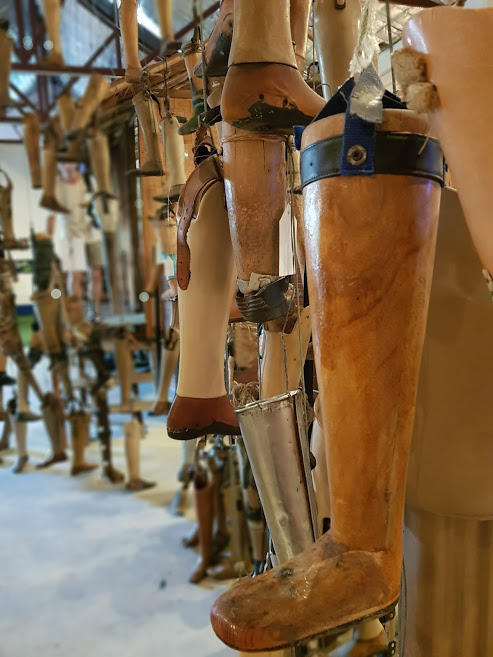
The COPE centre is not just a museum about Laos’ horrifying modern history, but also a rehabilitation centre for survivors of explosions from Unexploded Ordnance (UXOs) and other people with mobility related disabilities. To put this more simply, the COPE centre arranges surgery, makes prosthetic limbs and gives physiotherapy to Laotians who have been blown up by unexploded bombs or involved in road traffic accidents. I hope I’m not exaggerating by saying that fewer more worthwhile causes exist.
If you’re wondering why so many people in Laos suffer injuries from UXOs and why there is such a need for the COPE centre’s services, then let me give you the facts and figures that are well-known in Laos, but relatively unknown elsewhere:
- From 1965 to 1973 (during the Vietnam war), the US dropped over 2 million tonnes of ordnance on Laos in 580,000 bombing missions
- That’s the equivalent of 1 planeload of bombs dropped every 8 minutes, 24 hours a day, for 9 years
- This means that more bombs have been dropped on Laos than on all countries during World War II, and makes Laos the most heavily bombed country per capita in history
- More than 270 million cluster bomblets (known as “bombies”) were dropped during the bombing campaign
- Between 10-30% of bomblets did not explode on impact (estimated at 80 million), meaning that huge parts of the Lao countryside are still littered with UXOs that remain as deadly today as they were when they were dropped.
Unexploded bomblets don’t normally explode when trodden on, but can be triggered by farmers working the earth with tools, children digging them up and playing with them, or even the heat from a nearby cooking fire. Due to the value of their metal components, some poorer Lao people also resort to collecting them with cheap metal detectors, risking everything in an economy where opportunities are scarce. Since 1964, around 50,000 people in Laos have been killed or injured by UXOs. Even today, around 40 people are killed or injured by UXOs each year.
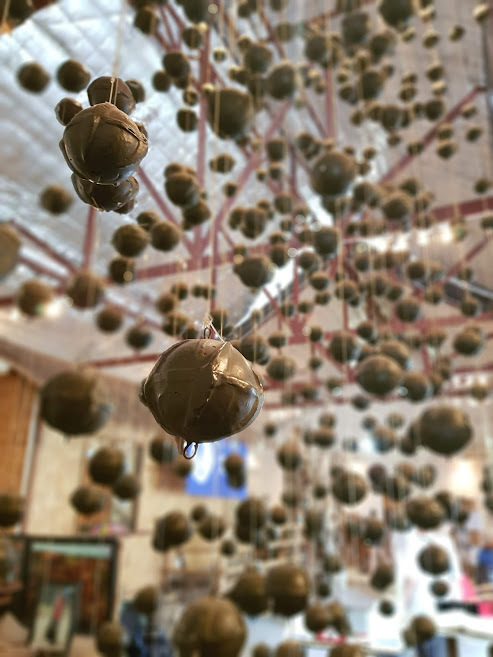
If you’re wondering why Lao people are still exposed to the risks of UXOs, the films, stories and testimonies available at the COPE centre make it abundantly clear that most Lao people don’t have any other option. Most rural Laotians face an impossible choice between farming their nearby land and exposing themselves to the risk of UXOs, or not being able to feed their families. When a bombie is found by a villager, it sends waves of paralyzing anxiety throughout the village, as they know that the likelihood of finding more is very high. Lao UXO clearance teams are not close to meeting the demand to clear UXO-contaminated areas, and less than 1% of undetonated UXOs have been destroyed.*
The personal stories arising from this ongoing humanitarian crisis are nothing short of heart-wrenching. A farmer whose hands, feet, stomach and eyes were mutilated when a cooking fire in his own home set off a bombie beneath the earth, left unable to work and barely able to watch over his children. A man who fashioned his own makeshift wooden leg which he used for 36 years before it was replaced with an advanced prosthetic by COPE. Eye-witness accounts of survivors who watched their friends and neighbours blown to pieces during the bombing so many years ago. Each story has been honestly and delicately captured by the COPE centre in such a way that allows visitors to intimately empathise with UXO victims. At the end of the day, these are people just like us, who are just trying to make a living, except that every day they have to walk through a literal minefield to do so.
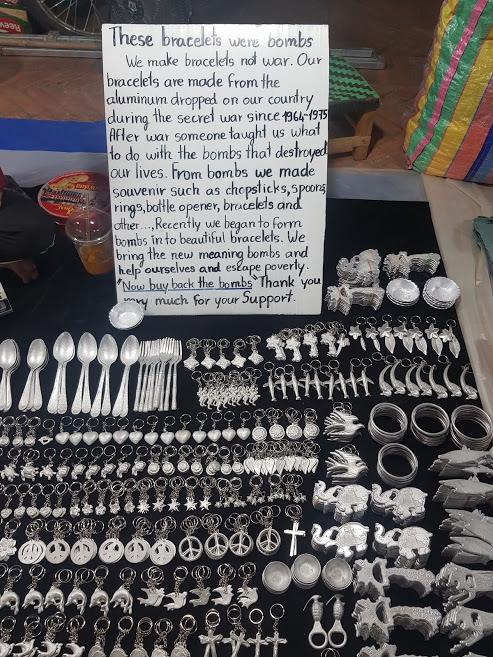
The COPE centre is keen to point out the socio-economic impact too. Without UXO clear fields, Laotians can’t even put food on the table, let alone start developing the countryside for larger agricultural or industrial projects. Historically, UXOs are almost certainly one of the contributing factors as to why Laos is well behind its neighbours in terms of economic development.
If you have any prior knowledge of the ‘Secret War’** on Laos by the US during which so many cluster munitions were dropped or have ever visited Laos yourself, then you’ll know that the information I’ve provided here captures only a few broad strokes of Laos’ history and the far-reaching impact of this catastrophic campaign. But if you didn’t know any of the above, then I’m glad to be doing my small bit to raise awareness.
*Further research whilst writing this post revealed that the US has contributed an average of $4.9M per year for UXO clearance in Laos (from 1993 to 2016). This might paint the picture that the US is on its way to atonement until you find out that the US spent $13.3M per day (in 2013 dollars) for 9 years bombing Laos. That means that the US has spent less on cleanup in 24 years than it did in 10 days of bombing. Source: http://legaciesofwar.org/about-laos/secret-war-laos/
**I’m no historian, but my understanding from visiting the COPE centre and doing some basic online research is that the US had 3 main reasons for bombing Laos so heavily during the Vietnam war: (1) to disrupt Vietcong supply lines which moved through large areas of northern Laos, (2) to support the Royal Lao Government against the communist Pathet Lao (allies of the Vietcong) during the Laotian Civil War, as part of the US’s policy to contain communism, and (3) because it was too dangerous for US bombers that had not found their targets in Vietnam to land whilst carrying so many explosives. I’m tempted to offer my political opinion on this matter here, but I don’t think it’s the right place.


 The Burnout Blog
Woah, very insightful and thought provoking.
LikeLike
Thanks for a concise and informative piece. I can’t believe I am only just learning about this!
LikeLike